†Christology of The Quadrants of the Cross†
Essay #17: Corrective Practice No. 3: Building Your House on Rock
Watch out for false prophets. They come to you in sheep’s clothing, but inwardly they are ferocious wolves. By their fruit you will recognize them. Do people pick grapes from thorn bushes, or figs from thistles? Likewise, every good tree bears good fruit, but a bad tree bears bad fruit. A good tree cannot bear bad fruit, and a bad tree cannot bear good fruit. Every tree that does not bear good fruit is cut down and thrown into the fire. Thus, by their fruit you will recognize them.
Not everyone who says to me, “Lord, Lord,” will enter the kingdom of heaven, but only the one who does the will of my Father who is in heaven. Many will say to me on that day, “Lord, Lord, did we not prophesy in your name and in your name drive out demons and in your name perform many miracles?” Then I will tell them plainly, “I never knew you. Away from me, you evildoers!”
Therefore everyone who hears these words of mine and puts them into practice is like a wise man who built his house on the rock. The rain came down, the streams rose, and the winds blew and beat against that house; yet it did not fall, because it had its foundation on the rock. But everyone who hears these words of mine and does not put them into practice is like a foolish man who built his house on sand. The rain came down, the streams rose, and the winds blew and beat against that house, and it fell with a great crash. -Matthew 7:15-27 (NIV)
Corrective Practice No. 3: Building Your House on Rock
The Gospel
This Gospel comes at the end of the Sermon on the Mount. The first two sections are connected by a certain parallelism. The third and final section is a highly condensed expression of the conclusions that can be drawn from the first two. This final section is not merely a summation or reflection on the Sermon on the Mount as a whole. It is that. But it is made more powerful by being a summation of the implications of the two sections immediately prior, which are themselves a kind of condensation of the Sermon on the Mount as a whole.
We should have expected that Jesus was about to lead us into a passage that narrowed all he said before down into a few carefully chosen words. For just prior to these three last sections we read:
Enter through the narrow gate. For wide is the gate and broad is the road that leads to destruction, and many enter through it. But small is the gate and narrow the road that leads to life, and only a few find it. (Matthew 7:13-14)
Thereafter, Jesus launches into his peroration.
Let us recall that the Sermon on the Mount is essentially a call to action and a guide for conduct. Even a brief perusal acquaints us with famous excerpts such as these:
Blessed are the meek,
for they will inherit the earth.
You are the light of the world. A town built on a hill cannot be hidden…In the same way, let your light shine before others, that they may see your good deeds and glorify your Father in heaven.
For I tell you that unless your righteousness surpasses that of the Pharisees and the teachers of the law, you will certainly not enter the kingdom of heaven.
You have heard that it was said, “You shall not commit adultery.” But I tell you that anyone who looks at a woman lustfully has already committed adultery with her in his heart.
You have heard that it was said, “Eye for eye, and tooth for tooth.” But I tell you, do not resist an evil person. if anyone slaps you on the right cheek, turn to them the other cheek also.
You have heard that it was said, “Love your neighbor and hate your enemy.” But I tell you, love your enemies and pray for those who persecute you, that you may be children of your Father in heaven.
But when you give to the needy, do not let your left hand know what your right hand is doing, so that your giving may be in secret. Then your Father, who sees what is done in secret, will reward you.
Do not store up for yourselves treasures on earth, where moths and vermin destroy, and where thieves break in and steal. But store up for yourselves treasures in heaven, where moths and vermin do not destroy, and where theives do not break in and steal. For where your treasure is, there your heart will be also.
You cannot serve both God and money.
Therefore I tell you, do not worry about your life, what you will eat or drink; or about your body, what you will wear…But seek first his kingdom and his righteousness, and all these things will be given to you as well.
Do not judge, or you too will be judged.
Ask and it will be given to you; seek and you will find; knock and the door will be opened to you.
In instance after instance, we are told not only what to do and what not to do but how to conduct ourselves in performance of the action. In other words, Jesus offers not only a prescription for action but also a guide to the conduct of the heart inside the action. Thus he offers both external and internal frames of reference for the Way of Return to God.
If we now take a glance at the two next to last sections of the sermon, we can see that the first of them is fully about external frames of reference, while the second is about internal frames of reference. In the first we are told to recognize false prophets by external frames of reference, namely, by their fruits. In the second we are told to gauge external actions by their internal frame of reference, namely, whether or not they spring from “the will of my Father who is in heaven.”
There is a parallelism or mirroring here, because in one case the external manifestation or fruit reveals a spoiled internal disposition, i.e., falsehood, and in the other case a deficient internal disposition, i.e, a lack of connection to God’s will, reveals ungrounded external manifestations or actions. Furthermore, there is an unspoken but likely connection. There is a reason why Jesus chooses to juxtapose his discussion of false prophets with his discussion of false disciples. This is because the false disciple is very likely to be a disciple of a false prophet, and a false prophet is also very likely to be a leader over false disciples. Thus Jesus is giving a double warning both not to close off one’s connection to God’s will in the performance of one’s actions and not to substitute for that connection an attachment to the will of an impostor. To the false leader, the implicit warning is parallel, first to reconnect herself to the right trunk and the right root, namely, the Father, so that she might once again begin to bear good fruit. Second, Jesus would warn her not to hold sway over others in her corrupt state but to disband her disciples at least until she had dealt with the corruption in her own heart.
With this background, we can now come to understand the last section in the Sermon on the Mount. For the disciple whose actions emerge from the will of God is like the person who builds his house upon the rock. Insofar as his actions do not devolve from the false motives, attachments, or aversions of his ego but from the Father’s will, they are strong like rock. The changing climates and conditions of the human world cannot topple them, at least not easily. On the other hand, the person who does not practice what Jesus is teaching about keeping connected to the will of the Father is like one building on sand. The changing conditions of the world, the ever variable sway of desire and derision, and the variable moods and predilections of godless leaders guarantee that actions undertaken without connection to God’s root and foundation will blow away like dust (false disciples) or come crashing down in great ruin (false prophets). Thus when Jesus exhorts us to put his words into practice, he is specifically referring to the words of the prior two sections, and by extension to the words of the entire Sermon on the Mount. These final three sections frame everything that came before, as Jesus himself implied, in a “narrow gate.”
Looking through that gate, we can in fact find mentioned all the Quadrants of the Cross.
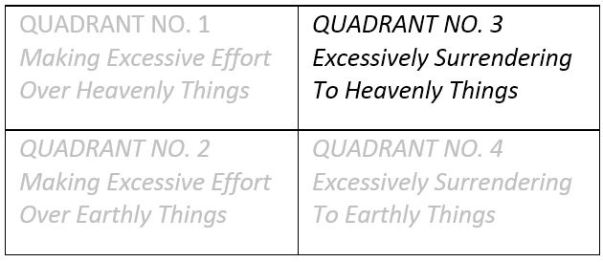
There are those false prophets driven to grandiose displays of spiritual effort without being sufficiently grounded in the Lord (Quadrant No. 1). Then there are those who would work mightily tending to the money and treasures of this world with little sense that only surrender to God offers any sort of permanency and eternal satisfaction (Quadrant No. 2). Thirdly, there are those who would surrender their hearts to the will of delusional gurus and perfidious pastors, whose outward actions are tainted by ideologies and strange allegiances (Quadrant No. 3). Finally, there are those who surrender to the seductions of the earth, who are consumed in their hearts by lust or by worry for the things they want or need (Quadrant No. 4). These are those who lose their “saltiness,” their spiritual flavor. These are those who keep their light hidden, overly surrendered to what holds them, unable to make an effort to stir their light and share it abroad in the performance of good deeds. All of these types of sin are specifially addressed in the Sermon on the Mount. What the last three sections do is to help us frame them into pairs that further reveal their inner workings and their interrelationships. For what we are doing with the false prophet and the false disciple, we can do with other pairs on the Quadrants of the Cross. Jesus’s overarching intent is to give us a broad feeling for the tensions and dynamics that pull us away from him at the center of the cross and also for the practices that can harness those same dynamics to rebalance and restore us to him. Having said that, Jesus’s teaching here at the end of the Sermon on the Mount can also be seen to apply quite specifically to missteps into Quadrants No. 1 and No. 3.
In Essay #15 we already encountered a specific practice to address error in Quadrant No. 1. The Pharisees and the false prophets Jesus mentions here are cut from the same cloth. Both may be said to have spiritual intent and both err in allowing that intent to become inhabited by an ego whose own efforts usurp the will of God. We saw that the grounding and deflating practice of doodling can reestablish a connection with humus seen metaphorically as humility and thus correct the error in question and recenter the heart with Jesus on the cross. Let us focus more closely, then, at what Jesus has to teach us here about error in Quadrant No. 3 and its correction.
In a short space we are given extensive information about false disciples. Jesus implies that they are the sort who would offer fulsome salutations: “Lord, Lord.” He plainly states that they make many claims, such as to prophesy, driving out demons, and performing miracles. Yet he also makes clear that these are not the sort who will enter into the kingdom of heaven. One has to wonder why not if in fact such claims were true and these disciples did do good works. For elsewhere Jesus specifically told John that he and others should not stop a man driving out demons in Jesus’s name even though the man was not of their fold.
“Do not stop him,” Jesus said, “for whoever is not against you is for you.”
(Luke 9:49-50)
Jesus himself pointedly answers the question about the present disciples saying that “he never knew them.” As we have already noted, their actions did not spring from “the will of my Father who is in heaven.” Apparently these disciples were not the sort who were truly for Jesus, for the Father, and for the true disciples. Given what Jesus said to John, they might have been, had their actions been and done what they claimed. But the broader implication must be that their claims were hollow. Either they did not do the things that they claimed and their words were all bluster of the same sort as “Lord, Lord!” or they did do them but by some other power than the will of God. Since humans cannot do such things on their own, one might think that Satan had empowered them. However, as Jesus answered the Pharisees who accused him of being empowered by Satan,
If Satan casts out Satan, he is divided against himself; how then will his kingdom stand? (Matthew 12:26)
Rather it is more likely that the false disciples did not do what they claimed although they may well have believed that some other member of their group had done them. In particular, it is the currency of many such disciples of yesterday and today to invest ardent faith and trust in the leader of their group and to believe without question all manner of tales pertaining to that person’s spiritual accomplishments. Seen through this lens, such disciples really do not do much except surrender to a spiritual or quasi-spiritual authority, so that their error fully exposed consists of excessively surrendering to heavenly things.
Lest this sin take on the look of “gold that is too bright” and cause us to wonder how too much of a good thing can be a bad thing, we should at once draw a comparison with Mary. For Mary also had surrendered to heavenly things by seating herself at the feet of Jesus. Let us recall what we said at the conclusion of Essay #16, that while we live in human form it is not in fact given to us to drop completely down the rabbit hole and leave our earthly physical realm. The surrender of Mary to Jesus was offered in context as a corrective to the excessive effort over earthly things exemplified by Martha. Jesus did not mean for Mary to remain at his feet indefinitely chanting, “Lord, Lord!” nor for her never again to help Martha with the housework. He only meant that the “one thing needed” symbolized by her sitting at his feet should not be taken from her, that is, her mindful connection to the Father. And this, in fact, was something that Mary by all indications could and did maintain as she went about her earthly tasks without disappearing down the rabbit hole. The false disciple, by contrast, gives everything over to the false messiah and hardly arises from his prostrate position, or if he does, he is so totally obsessed with the guru–whether an actual person or a religious ideology–that he spins incessantly around her accomplishing little of note in the world. The guru herself may very well have somewhat of an heavenly or spiritual intent. In that sense, then, the false disciple has overly surrendered to heavenly things.
As for the guru, were she herself fully centered with Jesus on the cross, then she would interrupt the fulsome praises of her adorers as Jesus interrupted the rich young ruler:
Why do you call me good? No one is good except God alone. (Mark 10:18)
She would insist that her disciple arise and go build his house on the rock that is God alone instead of taking for his foundation the guru’s own ego, let alone what may be her addictive personality, her cultish ways, and what have you. History offers plentiful examples of religious leaders–and political leaders, too–who have led many followers astray by the force of their personalities. But the noblest leaders and teachers always do what Jesus did. They deflect attention away from themselves to the Most High who is the source of their wisdom. And they often direct their students back into the world of work where they can refine their spirits and come through experience to have greater knowledge of the Lord. Once again we think of Matthew 25 and of those who are not yet ready for the Lord’s coming. The oil in their lamps is too spare. They must go off “to those who sell, and buy for themselves.” They must endure the refinement of life experience and acquire the discipline of spiritual practice in order for their lamps to fill, in order for God-awareness to catch fire in them.
Hence does Jesus counsel the disciple to do like the wise man and go and build his house on the rock. To have God as our foundation is the goal of all spiritual practices, so in this sense Jesus is aptly summarizing the whole of his Sermon on the Mount. However, taken as a specific temporal process in contradistinction to building on sand, building on rock can be seen to be a corrective practice to the kind of spineless adulation that consumes the false disciple. Whereas the false disciple evades work in the world through surrender to personality or ideology–a foundation of sand–the true disciple is directed to embrace work in the world in such a way that the house he builds is strong, i.e., on rock.
Jesus is teaching us that we each much choose how to build. And that far from work in the world being a mere distraction from “the spiritual life,” it can be a corrective practice to draw us back from a kind of spiritual seduction. Whatever fantasies we might construct down the rabbit hole must ultimately remain there; they are not meant to replace life on earth. On the other hand, work in the world can tame and refine such fantasies. Under the blowtorch of physical labor the stuff of our dreams can be forged into the steel that holds life strong, which is the manifestation of God’s will in every arch and in every beam. What Jesus is telling us is essentially what we have been reflecting all along, that we are not born into God-awareness, or if we are then it slips away under the tides of this world. For most of us, at least some of the time, we have to pull ourselves back out of those tides with brute strength. Ultimately, it is the Lord’s strength we lean on because he is our rock. But we still have to come to that rock of our own choosing, and we still have to build. As we read in Genesis, the Lord gave us to toil on this earth and so that is also how we can glorify him. We must guard against working in the world to the exclusion of his will–which was the distraction of Martha–but work instead to refine ourselves as discerners and doers of his will. Sometimes, in fact, it is back to work of this sort that our path to Jesus leads and away from the sanctuary of the ashram or the lulling chants of the church. Thus can effort applied to earthly things be the corrective practice to excessive surrender to heavenly things.
Applying the Practice
The Greek word for house is oikos, from which we get economics, itself formed from oikos plus nomos, the Greek word for law. Economics in its root meaning refers to the laws or principles that govern the household, and by extension, the community at large. The principles or foundation upon which we choose to build our house affect not only ourselves and our individual families but also affect the larger communities in which we live. Economics, then, involves choices which deeply affect the ways that households relate to one another and how the community functions as a whole. Choices made, for example, out of narrow interest or peculiar allegiances are unlikely to benefit the overall community. And the room for error here is staggeringly wide. Mistakes made in the degree and choice of world work that one undertakes in the building of her house are likely to range much farther afield than the example set by Martha in distracting kitchen work. Jesus specifically addresses those who would “store up for themselves treasures on earth” and warns them to guard their hearts from the effects of doing so. Rather, he says:
But store up for yourselves treasures in heaven, where moths and vermin do not destroy, and where thieves do not break in and steal. (Matthew 6:20)
Jesus was not against world work. When the Pharisees asked him if it was right to pay the imperial tax set by Caesar, he took a coin, pointed to Caesar’s image, and said:
Whose image is this? And whose inscription?…So give back to Caesar what is Caesar’s and God what is God’s. (Matthew 22:20-21)
In the same breath Jesus advocated paying taxes–and, by extention, work–and reminded us not to let it become divorced from what we owed to God. That was his main point. He was, in fact, defining an economics based on the influence of God’s will and claiming–quite astonishingly–that we could do his will harmoniously even under the conditions imposed by Caesar.
In more modern times, we have seen the development of an economic philosophy often attributed to Adam Smith in which the rich are led by “an invisible hand” to work in such a way as to advance the interest of society as a whole. This philosophy has often been associated with so-called “laissez-faire economics” where the invisible hand operates despite the radical self-interest of merchants and others with a controlling interest in the distribution of resources. Adam Smith himself actually said that “by acting according to the dictates of our moral faculties, we necessarily pursue the most effective means for promoting the happiness of mankind.”1 This statement contradicts the view that the invisible hand is merely a feature of the “clockwork of the universe” which runs independently of our intent. Yet Smith clearly did also believe that many of the positive outcomes of a marketplace or economic system were beyond our ability to reconcile with the players’ will or intentions.
We are taken back to our discussion of free will and determinism in Essay #7. In the context of that chapter we could ask here: If not by the operation of a purely material causality nor by the stalwart application of our will to promote the happiness of mankind, then how do we account for the possibility of an economy which can truly be for the benefit of all? If we believe, as Jesus reassured us, that it is truly possible to give both God and Caesar their due, to what–or to whom–can we attribute that possibility? What, then, is “the invisible hand” upon which Adam Smith encouraged us to depend?
The answer here follows the path that we anticipated in Essay #7. The spaciousness of God’s creation allows for more than either the impersonal workings of determinism or the limited foresight and range of our will. Rather, the Principle of Expansion is that by which “God is continually creating the universe,” to quote Eckhart again. Smith was right that we are capable of “acting according to the dictates of our moral faculties.” He was also right that when we do so, “we necessarily pursue the most effective means for promoting the happiness of mankind.” What he strove to capture with the term “the invisible hand” was the elusive connection that gets made time and time again between even our frailest moral sentiments and outcomes that are for our greatest good. He understood that somehow the economic whole was far more than the sum of its parts, but he struggled to say how, which has led to confusion and to the opportunity for many different economic camps and theorists to claim him as their own. Smith, however, was a God-principled man, and he would not entirely have tolerated the notion put forth in modern secular laissez-faire economics that positive economic outcomes accrue to society completely independent of God’s will. Perhaps such outcomes sometimes accrue despite the failure of the participants either to heed or to have much moral sentiment. But that they occur untouched by the Creator’s hand is a notion that would no doubt have offended his spiritual sensibility.
Rather, Jesus exhorts us to allow God’s will to be done even as we pay Caesar his tax. The implication is clearly that God’s will can be done even under these circumstances that are less than ideal. This affords us a finer insight into what Jesus meant when he told us to “build our house on the rock.” The rock is not the range of our will. It is not the effectiveness of our efforts, nor the outcomes thereof. It is not even our moral sentiments. Nor is it false belief in a cosmological clockwork, a deterministic universe that somehow blindly issues in altruistic outcomes. The “invisible hand” that Adam Smith wrote about can be none of these things. It is instead the hand of God, that is, God’s own will that he makes manifest in the midst of actions that reach towards him. For God, even the payment of tax to Caesar is not too lowly a task that he cannot elevate it to something higher. The key for us is whether we do what we do from the intention of building on the rock of God’s judgement and will or from another intention which is the property of our ego.
What Smith referred to as “our moral faculties” would indeed be the moral sentiments which guide us in offering discernment of our choices. The light that is already in us can guide us toward still greater light. The small right effort we make today can issue in greater strength tomorrow and in greater insight with which to approach more difficult challenges. Thus the world work that can realign us with Jesus and correct the error of Quadrant No. 3 is not any world work but that which invites the will of God to inhabit it. It is not the distracting work of Martha and still less the avaricious exploits of the tax collectors and the money lenders. It is rather the soulful work of the apostles and followers of the early church depicted in the Book of Acts where:
All the believers were together and had everything in common. They sold property and possessions to give to anyone who had need. (Acts 2:44-45)
We can dig ruts in the sand with our prostrations before false prophets. We will then taste the wind of false promises and false claims in our faces as they blow back at us. We can work to accumulate money and possessions. Then we will watch the treasures of this earth be consumed by rust and vermin and moth, while our hearts corrode also through attachment to these things. Or we can engage in world work with our hearts kept open to God’s judgement and will to lead and inspire us. Then we will have met the antidote to the spiritual malaise of Quadrant No. 3 and be able to rise from the narcolepsy of excessive subservience to unrefined spiritual ideals into the wakeful temperance that comes from engaging in the world with God’s mountain at our back. Then we will have begun laying up treasure in heaven which no rust nor moth nor vermin can destroy.
The spiritual practice of building our house on the rock thus begins with the famous command of the Star Trek captains: “Engage!” It is probably not so important what work we choose as that we choose it with the right heart and spirit, for once again, Jesus taught us that even paying taxes to Caesar could be accomplished while “giving back to God what is God’s.”
Ideally, however, world work will emerge over time which is a better and better match for the talents and gifts God gave us. Ideally, by following his will and making it our own we will come more fully into that purposeful living he dreams for us, into what Buddhists call “right livelihood.” For what is right livelihood other than the life he promised us in his kingdom? Jesus taught us to pray:
Thy kingdom come, they will be done, on earth as it is in heaven.
What is this if not a promise that God’s kingdom could be realized on earth, that his will could be done? What is it if not an encouragement to rise up singing and planting and harvesting and mowing in soulful expectation that God will give us our daily bread and much more than our daily bread. Through such action and such expectation we can once again give freely to our brothers and sisters in need. We can return to the economics of soulful living and not of mere monetary gain, the only economics which can truly set all households and all persons into right relation with each other again.
Looking back now through the narrow gate upon the Sermon on the Mount as a whole we can once again view it as a call to action, seen now as a guide both by internal and by external markers how best to conduct ourselves so as to manifest God’s will. Stay reserved in spirit. Remain unpretentious in appearance. Hunger after righteousness. Show mercy to others. Come from a pure heart. Act so as to foster peace among others. These are some of the internal and external markers that Jesus teaches at the opening of his sermon. As we read on we encounter many more such guideposts arranged in a similar manner. These are where we can begin. Even so, the will of God is what it is. It cannot be completely reflected or contained in any of these prescriptions nor in the Law itself. About that Jesus exhorted us to obey the Law but then added, almost in irony, that we should be more righteous than the Pharisees and the Scribes themselves, i.e., than those who were the exemplars of observing the Law. In short, the will of God surpasses even the Law. Yet Jesus reassured us:
Ask and it will be given to you; seek and you will find; knock and the door will be opened to you. For everyone who asks receives; the one who seeks finds; and to the one who knocks, the door will be opened. (Matthew 7:7-8)
In answer to our aspiration to build his kingdom, our dedication to do his will, and our trust in his wisdom, God offers guidance. He sends help to his people. He opens a path where before there seemed none. God’s kingdom is forever ready to arise tomorrow like the sun which comes in answer to the moon’s flickering call.
Notes:
- Adam Smith, The Theory of Moral Sentiments, Vol. II, page 316.
 Karunandaji's Mind