†Christology of The Quadrants of the Cross†
Essay #16: Corrective Practice No. 2: Sitting at the Feet of the Master
Now as they went on their way, he entered a certain village, where a woman named Martha welcomed him into her home. She had a sister named Mary, who sat at the Lord’s feet and listened to what he was saying. But Martha was distracted by her many tasks; so she came to him and asked, “Lord, do you not care that my sister has left me to do all the work by myself? Tell her then to help me.” But the Lord answered her, “Martha, Martha, you are worried and distracted by many things; there is need of only one thing. Mary has chosen the better part, which will not be taken away from her.
-Luke 10:38-42 (NRSV)
Corrective Practice No. 2: Sitting at the Feet of the Master
The Gospel
Here we encounter Martha, the quintessential “do-gooder.” In Catholicism, Martha is the patron saint of cooks, housekeepers, and the helping professions in general. Her name means “lady” in the sense of “mistress of the house.” She thus invites comparison with the master of ceremonies at the wedding Jesus attended in Cana.
In Martha we find the embodiment of the inclination to serve, not only to run the kitchen, but to set all things in order for the benefit of the household. Martha’s talisman is service, and she is obviously used to witnessing its magical effects. Otherwise, she would not have taken to scolding Jesus himself when all her efforts failed to stir those sitting at his feet into action. Among them was Mary, her sister. So it was natural for her to single that one out and complain to Jesus that he was doing nothing to stir Mary into action. Surely, there were others who sat there, too, along with Mary. But Martha names only Mary.
The scolding of Jesus is not something we encounter rarely in the Gospels. It is actually not uncommon. However, Martha has the distinction of scolding Jesus not once but twice. When Jesus arrives in Bethany 4 days after the death of her brother, Lazarus, Martha confronts him while Mary stays at home. She says: “Lord, if you had been here, my brother would not have died.” She tries to believe in him, adding: “But even now I know that God will give you whatever you ask of him.” However, when Jesus tells her that her brother will rise again, the best she can do is profess belief in the resurrection on the last day. She is clearly upset that Jesus did not arrive in time to do what he should have done. This fits very well with what we already know about Martha, that she is all about doing the right thing at the right time. Jesus, by intentionally delaying his arrival, has set the stage not only for her disappointment, but for the total collapse of the worldview upon which it depends.
When Jesus answers Martha that she is “distracted by her many tasks” and defends Mary as the one who has “chosen the better part,” that is, the “one thing” only that there is need of, his response is somewhat cryptic. He does not go on to explain what that “one thing” is. But when he responds to her second scolding, Jesus does not leave anything unclear. He responds: “I am the resurrection and the life. Those who believe in me, even though they die, will live, and everyone who lives and believes in me will never die.” When she doubts again in front of Lazarus’s tomb Jesus reiterates: “Did I not tell you that if you believed, you would see the glory of God?” At this he looks upward and says, “Father, I thank you for having heard me. I knew that you always hear me, but I have said this for the sake of the crowd standing here, so that they may believe that you sent me” (John 11:21-42).
The one thing only that there is need of is that upon which life itself depends. Jesus himself defines it as “belief.” And although he frames it as belief in himself, he clearly means it as belief in the Father who sent him, for he says explicitly that belief reveals the glory of God. He looks heavenward toward the one true Source of his power and thanks God for hearing him, and by implication, for granting that power. He further elucidates that it is for the sake of others that he has asked for this power, not for his own sake. Clearly, Jesus does not mean to imply that it is belief in him as a person that gives life, but only as a manifestation of the Father and the Father’s power and grace. In other words, all of Jesus’s personal effort stands as nothing compared to his utter trust in and reliance on the Father. Jesus expresses this trust in the words, “I knew that you always hear me.” It comes as the ultimate answer to his own personal weeping both for the death of Lazarus and for his sisters’ deep grief.
Both the death and the inexorable grief of Mary and Martha represent the total collapse of human effort. Death is seemingly so final. There is nothing left to do, nothing one can do, except collapse into total surrender to grief. That is how it seems. That is how it always seems in the context of a worldview where goodness is defined by effort, for example, by showing up on time and doing the right thing. Jesus was late. Lazarus died. Martha scurried about handling all the tasks related to the household and the kitchen. Mary sat still at Jesus’s feet and would have left the house in shambles and the meal uncooked. Where effort defines what is good, the lack of effort is considered wanton. What Jesus is showing, however, is that, ultimately, all merely human effort comes to naught. Death is final. Grief is inevitable and inexorable, that is, as long as we are wedded to a worldview whose borders are defined by the limits of purely human effort. Within such a worldview surrender certainly is death. And weeping is all that one hears at the far edges of this universe.
Jesus himself was not immune to lamentation. He himself wept at the weeping of Mary and Martha and the other friends of Lazarus who had gathered. But Jesus was also not limited by this weeping. He lived in this world, but he was not of it. Rather, because he dwelled fundamentally in the Father, he could cross the limit border of this world and report back from the next. He could show us that surrender in this world is one thing, while surrender from the point of view of the next world is another. Thus he intentionally juxtaposed the hopeless weeping of Martha with belief and trust in the Father. He juxtaposed surrender seen as the antithesis of the goodness of human effort with surrender literally resurrected as trust which extends beyond the limits of all human effort. For Martha, doing had been the watchword by which the very goodness of life was measured, whereas any kind of idleness–let alone death–spelled damnation. By contrast, Jesus shows that surrender to the Father is that which balances all human doing, all effort. Without such surrender, doing becomes an end in itself. Ultimately, it bolsters the ego and conjurs up a false sense of power. Doing which remains anchored in the kingdom must be counter-balanced by surrender to the Father. It must ultimately be neutralized by trust in the will of the Father who sent us that extends beyond even physical death. This is what the Eastern masters mean when they insist that all action become non-action or wu wei. Wu wei is action without attachment to results. In other words, it is action which has been emptied of any ego in order that it might be inhabited by a finer will. The will of God is not always explicitly mentioned as it is by Jesus, but the teaching is the same.
Thus the “one thing” that is needed in the face of Martha’s attachment to effort of a physical sort is surrender to the Father represented by Mary’s sitting idly at the feet of the Master.
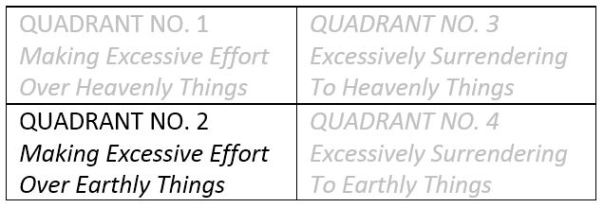
The more earthy or physical the effort or inclination to effort is, the more spiritual the surrender needs to be. In Martha’s case, her efforts seemed to be all about the baser physical necessities of the household and the kitchen. Hence, the counter-balancing practice offered by Jesus is for Mary to do no more than sit idly by the feet of the greatest living spiritual master. The ultimate extension of the kind of effort Martha embodies is effort which conquers death itself. Jesus answered this illusion by showing that it must ultimately collapse into the forced surrender of endless lamentation or be countered by trusting surrender to the will of the Father who is the ultimate author of life and death. Such surrender–and such surrender only–holds the hope that by crossing the limit border of effortlessness and death in this world we may partake of eternal life in the next. By sitting at the feet of the Master, we can practice the kind of surrender which will draw us back from the quadrant of excessive physical effort toward the Jesus point. The goal here is not to become idlers who take no effective action in the world, far from it. Rather, it is to engage in action that is at all times informed by the will of the Father rather than orchestrated by the ego. It is to remain empty of self in order to be filled by the Self or Spirit. It is to learn always to come from the Father, be it in action or stillness, so as to manifest his love, peace, and joy at all times.
In comparison, then, with the wedding master, Martha is–at least initially–like one drunk on cheap wine. Unable to tell the difference between the cheap and the fine wine, she is like one caught in a stupor scolding everyone for not drinking more cheap wine. The wedding master, by contrast, has retained his ability to discern the good wine from the bad. Once again, Jesus saves the best wine until the end. He saves it for Mary, whose name means “beloved.” He says she will not be denied it, but at last he gathers Martha to himself, too. He means to include all of us in the feast. Like the good shepherd he is, Jesus means for not one single lamb to go astray. He is teaching us here how to return most directly to the feast, how to enjoy most immediately the rich good wine of the Spirit.
Applying the Practice
If doodling brings us back down to earth as a corrective practice to overmuch effort of a spiritual kind, sitting at the feet of the master brings us down to earth in another way. It would be helpful, no doubt, to doodle as an antidote to excessive effort of a purely physical kind. Insofar as surrender to the slack character of doodling counteracts tense efforts in the physical or worldly realm, it can be a useful correction. However, the very nature of such efforts as building up storefronts, moving machinery, hauling children, calculating hedge funds, performing heart surgery, driving a bus, and cooking dinner already roots them in the earth. In Genesis we read:
Cursed is the ground because of you;
in toil you shall eat of it all the days of your life…
By the sweat of your face
you shall eat bread
until you return to the ground,
since from it you were taken. (Genesis 3:17-19)
All of our physical efforts stand in counter position to our inevitable return to dust. Hence, even the finger that moves idly in the sand is caught in the same compass. Thus the truest counter pole to physical effort is not surrender of a physical sort but spiritual. In the face of a day of grueling labor, what serves one better, to collapse into the arms of an easy chair, or to be wrapped and held by the arms of verses such as these?:
Truly my soul finds rest in God;
my salvation comes from him.
Truly he is my rock and my salvation;
he is my fortress, I will never be shaken. (Psalm 62:1-2)
I lift up my eyes to the hills–
from where will my help come?
My help comes from the Lord,
the Maker of heaven and earth.
He will not let your foot slip;
he who watches over you will not slumber;
indeed, he who watches over Israel
will neither slumber nor sleep.
The Lord watches over you–
the Lord is your shade at your right hand;
the sun will not harm you by day,
nor the moon by night.
The Lord will keep you from all harm–
he will watch over your life;
the Lord will watch over your coming and going
both now and forevermore. (Psalm 121)
The soft sand and the easy chair promise the kind of relaxation that can effectively ground and defuse excessive effort that is spiritual in nature. However, they do not offer a complete correction when the effort is already in orbit around things physical. For that, we need to be lowered along a different trajectory, specifically one that lands us back in the promise of non-physical being altogether. Psalm 62 promises rest in the Lord. And Psalm 121 carries that farther, stating that all things physical in fact answer to the Lord who is the very Maker of Heaven and Earth. Therefore, we are reassured that physical toil shall not, in the end, overcome us. To dust we shall return in our physical nature. However, the Lord will watch over our coming and going, not only now but forevermore. Any purely physical rest that we take is temporary. But our rest in the Lord is forever, and its promise can ease our physical burdens and return us from the toil of excessive effort to a place of centeredness with Jesus both at his feet and on the cross.
Martha, like most of us, was well-practiced at making physical effort. What she had difficulty discerning was the trajectory that her sister, Mary, was on that led to the feet of Jesus.
Or rather, she could observe it, but she could not discern it as something other than a collapse, a failure, much as we might observe a satellite falling out of orbit. If we were Mary, however, we would have to say that the satellite fell down a rabbit hole, or into a black hole, in any case, out of this world. We would have to say that we had come into the presence of that “one thing needed” that Jesus spoke of, that is, surrender to the Father so unconditional that it could carry us beyond the dust of this life and across the limit border where new life is to be found.
The challenge we face here is very different from that of recentering from overmuch effort in the spiritual or quasi-spiritual domain. Religious, political, and community leaders may well be caught up in spiritual ideals or ideologies that rise to inflated heights precisely because they are disconnected from the earth, from humus, ultimately from the humility which grounds such ideals in the limitations of human command and control. Nevertheless, the ideals in question may genuinely partake of the nature of the spiritual realm. In the case of purely physical enterprise and effort, excess involves attachment to the physical itself to the exclusion of the spiritual, so that the spiritual must be reintroduced together with the movement toward surrender.
This may in fact be a harder correction to make than the former because it involves a transition to a higher realm rather than the refinement or grounding of a higher order discernment by the laws of a lower realm. Thus in a way it was easier for Jesus to deal with the Pharisees about to stone the adulteress than it was for him to lead Martha (and many others) to the point symbolized by Mary at his feet. The Pharisees had an operant spiritual ideal, excessive though it was. Martha, however, was caught in a realm where discernment of the higher spiritual ideal was itself questionable. Her faith in Jesus’s connection to the Father seemed more rote than authentic. Hence, Jesus had to virtually blow a hole in her very world and lead Lazarus back through it to demonstrate to Martha that there was a level beyond and above her current orbit, a level she could paradoxically ascend to by trustingly falling to the feet of Jesus.
All this points the way for us ourselves, for we are much more likely to be like Martha with all our worldly busyness than Mary in her trusting simplicity and quietude. While we may not have Jesus to resurrect a dead brother before our eyes, we can emulate his example by turning aside the tombstone of our own sepulcher wherein are buried all our hopes for help. We, too, can call forth Lazarus, whose name means “God is my help.” We can ask God to hear our prayer and to open a passageway for us that leads from purely physical toil to the intimations of a life beyond.
As we sit in meditation, contemplation, or prayer we can ask God to give us rest, to be our salvation, to protect us from the elements, to watch over us in our coming and going, to send us help. The deeper we go, the longer will be the view that we take until “both now and forevermore” sound in us with the same tone. Our challenge is to interrupt our physical toil in order to make space for such meditation and recentering. It is as if God wants us to be the ones who take the first stones away from the tomb, as a sign perhaps of our sincerity. Then maybe he will answer our prayer according to his own time and his own will. This, like any other spiritual practice, does not command God to do anything but rather disposes us to be able to receive him when he comes. The promise of God’s help is not an empty one, or the scriptures would not be full of it. Our trust is well-placed. In fact, it is the very movement away from effort and control in this practice that recenters us, nourishes our trust in God, and once again makes us most able to discern and to receive help in the form that he offers it.
The difficulties of the life of toil are not to be underestimated. The technology that was supposed to free us from much of that toil has as much swept us into new currents of obsession and concern as afforded us any freedom. Not infrequently it may be necessary for us to literally sit at the feet of someone more adept at spiritual surrender than ourselves. The marks of such a one would be calmness of spirit, steadiness, and a simple and transparent faith in life beyond pouring into this world. If we can find such a teacher, that would be the best for us in terms of easing our difficulties and hastening our progress on the Way of Return. Next best would be to meet with friends who have dedicated themselves alike to the goal of following Jesus. Thirdly would be the path of praying and meditating on one’s own and regularly surrendering to God and his truths. This, in any case, is a vital part of the practice of sitting at the feet of the master, and it can be enhanced through the first two approaches.1
The heart of this practice is the cultivation of the discernment of the life that lies beyond the limit border of human effort, the life that flows to us effortlessly and not due to any merit, compulsion, or design of our own. It is life that flows to us out of God’s grace and love. Jesus came to remind us of the “one thing needed.” That is to receive the light at the feet of the master, called “darshan” in Hindu worship. John called it “the unhidden light that enlightens all men coming into the world.” He said that to those who received it and trusted in its name, “it gave to them the power to be offspring of God.” Trust and discernment are thus intricately connected. We practice to receive the light, to cultivate our trust in the light, and this in turn can empower us to have clearer discernment of the light, which further strengthens our trust.
The “one thing needed” in this practice ultimately recenters us on the cross on the Way of Return. While we live in human form it is not in fact given to us to drop completely down the rabbit hole and leave our earthly physical realm. Rather we are to remain inhabitants of this world while cultivating our openness and connection to the next. Even as we anticipate that world our role is to become conduits for its appearance here rather than escapees to the other side. Thus it is possible also for us to carry surrender to the spiritual realm to an extreme and too far. It is possible to become uncentered through overmuch surrender in the spiritual domain. It is this error or sin and a corrective practice Jesus taught for it which we will examine in the next chapter.
Notes:
1. It would be an omission if we did not also observe that being in nature can be an effective form of this practice of sitting at the feet of the master. It may be helpful to think of gnomes in the Tolkien sense, that is, as “creatures of knowledge”gained from living in deep connection to the earth. At the feet of centuries old tall trees such gnomes received and transmitted the teaching or the “one thing necessary” for happiness, peace, and joy.
Forest animals, too, should not be forgotten, nor the pets we keep whose soft wisdom threads us back to the ancient ways. The animals of the forest live in the Kingdom day and night. They have no desire to leave it and hardly understand that it may be stripped away from them. Our pets only want us to join them there in the small plot of forest thay secretly drag around with them underneath their feet. That “one thing necessary” they have no thought of ever giving up. We would do well to observe how they walk and sit upon that spot of ground, how they eat and drink upon it, and how they sleep with nary a care. We ourselves have shrunk our peace into such a small circle beneath our feet that we are forever falling out of it and stumbling like ones drunk on cheap wine, which indeed we are.
 Karunandaji's Mind